

Over 60,000 British soldiers became casualties in a single day at the Battle of the Somme—more than the entire population of many cities wiped out in just 24 hours. This staggering number represents just one of history’s most brutal battles that shocked history, conflicts so devastating they redefined humanity’s understanding of warfare’s true cost.
Throughout human civilization, warfare has evolved from small tribal skirmishes to massive industrial-scale conflicts. Yet among the thousands of battles fought across millennia, certain engagements stand apart—not merely for their strategic importance, but for their sheer brutality and the psychological scars they left on survivors and societies.
What makes a battle truly brutal? It’s the combination of massive casualties, extreme environmental conditions, innovative killing technologies, and the psychological horror experienced by those who lived through them. These conflicts didn’t just change military tactics; they fundamentally altered how civilizations viewed war itself.
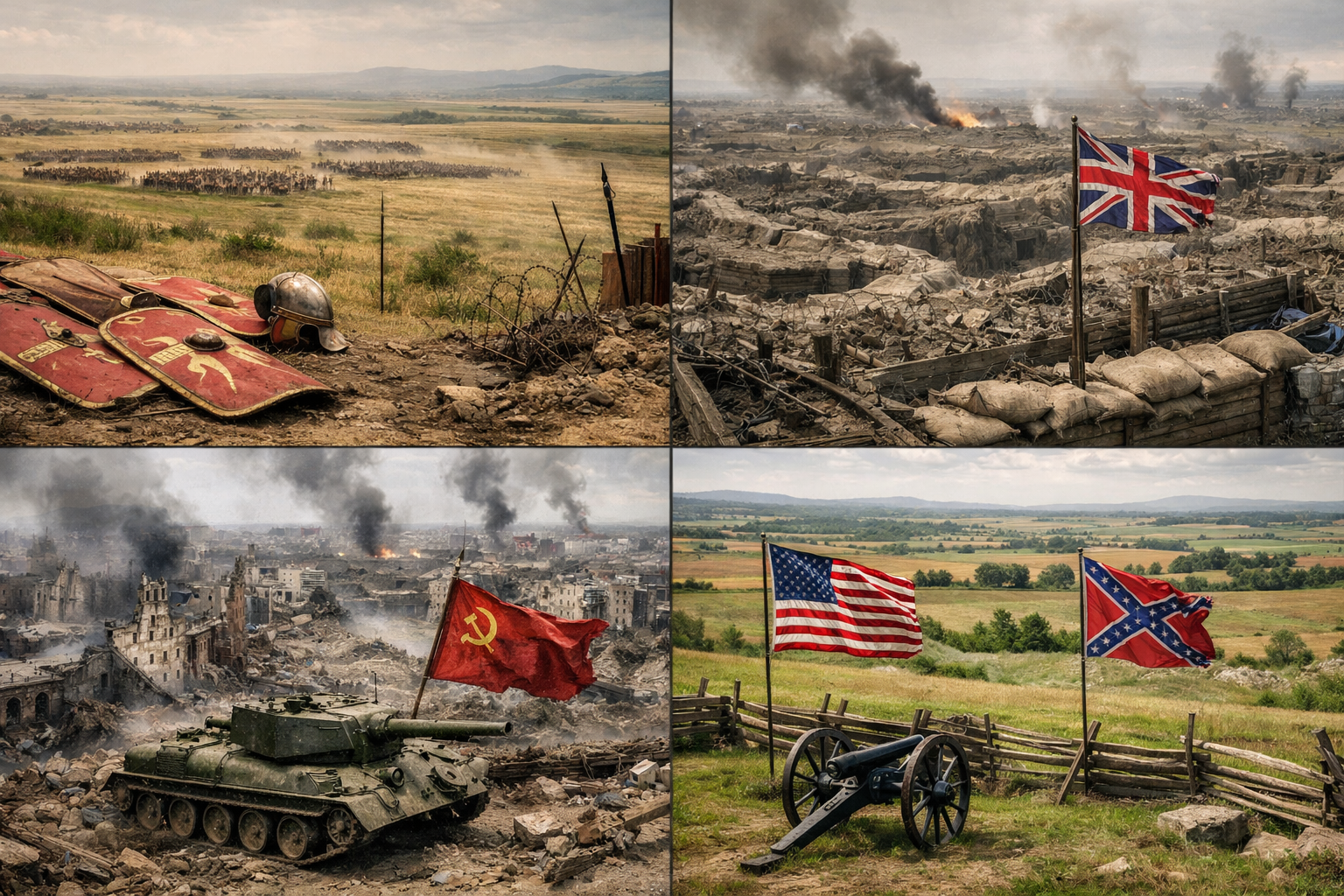
Key Takeaways
• Scale of destruction: These battles featured unprecedented casualty rates that shocked contemporary observers and changed public perception of warfare
• Technological evolution: Many brutal battles introduced new weapons and tactics that revolutionized military strategy and increased lethality
• Human endurance: These conflicts tested the absolute limits of human survival under extreme conditions of violence, weather, and deprivation
• Historical impact: Each battle left lasting scars on national consciousness and influenced political, social, and military developments for generations
• Universal lessons: Despite spanning different eras and continents, these engagements reveal consistent patterns about the true cost of armed conflict
The Ancient World’s Most Shocking Encounters
1. Battle of Cannae (216 BCE) 🏛️
The dusty plains of southeastern Italy became a graveyard for one of Rome’s largest armies when Hannibal Barca orchestrated what military historians consider the most perfect tactical victory in ancient warfare. This brutal battle shocked history by demonstrating how superior strategy could overcome numerical advantage with devastating results.
What Made It Brutal: Hannibal’s famous double envelopment—the “pincer movement”—trapped approximately 70,000 Roman soldiers in a deadly embrace. As the Carthaginian forces closed in from all sides, Romans found themselves pressed so tightly together they couldn’t raise their weapons. The slaughter continued for hours under the scorching Mediterranean sun.
The Shocking Moment: When the encirclement was complete, Roman soldiers began climbing over the bodies of their fallen comrades, creating literal hills of corpses. Ancient sources describe rivers running red with blood and buzzards so gorged they couldn’t fly.
Why It Shocked the World: Rome had never experienced such a catastrophic defeat. Nearly an entire generation of Roman nobility perished in a single afternoon, fundamentally changing the republic’s approach to warfare and foreign policy.
2. Battle of Agincourt (1415) ⚔️
In the muddy fields of northern France, England’s Henry V proved that medieval warfare’s age of chivalry was ending in the most brutal way possible. Heavy rains had turned the battlefield into a quagmire that would trap France’s elite heavy cavalry in a nightmare of mud, arrows, and close combat.
What Made It Brutal: English longbowmen unleashed volleys that could penetrate armor at 200 yards, while French knights, weighed down by heavy armor, became stuck in knee-deep mud. Many drowned in their own armor, unable to rise after falling. The battle devolved into what witnesses described as “butchery” rather than combat.
The Shocking Moment: When French reinforcements appeared, Henry V ordered the execution of French prisoners—a decision that violated medieval codes of honor but demonstrated the new ruthless pragmatism of warfare.
Why It Shocked the World: The flower of French nobility was destroyed by what they considered a ragtag English army. The battle proved that traditional military hierarchies meant nothing against superior tactics and new technologies.
3. Battle of Towton (1461) ❄️
England’s War of the Roses reached its bloodiest climax during a blinding snowstorm in Yorkshire, where two armies fought for over 10 hours in conditions so severe that archers couldn’t see their targets. This engagement became one of the brutal battles that shocked history for its relentless carnage in impossible conditions.
What Made It Brutal: Fighting continued through a snowstorm so intense that visibility dropped to mere yards. The wind gave Yorkist archers a significant advantage, allowing their arrows to fly farther while Lancastrian arrows fell short. Hand-to-hand combat in freezing conditions led to exhaustion, frostbite, and hypothermia alongside battle wounds.
The Shocking Moment: When the Lancastrian line finally broke, the retreat became a massacre. Soldiers fleeing across the frozen River Cock fell through ice and drowned, while others were cut down by pursuing cavalry. Bodies were reportedly stacked six feet high in some areas.
Why It Shocked the World: Contemporary chronicles described it as the bloodiest battle ever fought on English soil, with an estimated 28,000 casualties. The brutality of Englishmen killing Englishmen in such numbers horrified a nation already weary of civil war.
Industrial Age Warfare: When Technology Met Brutality
4. Battle of the Somme (1916) 💥
The rolling hills of the Somme River valley became synonymous with the industrial-scale slaughter of World War I. On July 1, 1916, British forces launched what they believed would be a decisive breakthrough against German lines. Instead, they walked into the most devastating single day in British military history.
What Made It Brutal: British commanders, believing their week-long artillery bombardment had destroyed German defenses, ordered soldiers to walk—not run—across no man’s land. German machine gunners, safely protected in deep bunkers, emerged to mow down wave after wave of advancing infantry. The mechanical precision of killing reached unprecedented levels.
The Shocking Moment: Within the first hour, entire battalions were wiped out. The “Pals Battalions”—units recruited from the same towns—meant that some communities lost nearly all their young men in a single morning. By day’s end, 60,000 British soldiers were casualties.
Why It Shocked the World: The scale of loss for minimal territorial gain challenged every assumption about modern warfare. The battle continued for months, ultimately claiming over one million casualties for advances measured in mere miles. This engagement exemplifies how brutal battles that shocked history redefined the relationship between technology and human life.
5. Battle of Verdun (1916) 🔥
“They shall not pass”—this French rallying cry became the symbol of human endurance pushed to its absolute limits. The German strategy of “bleeding France white” at Verdun created a 10-month nightmare that consumed armies and transformed a pastoral landscape into an apocalyptic wasteland.
What Made It Brutal: German artillery fired over 2 million shells in the opening bombardment alone. The constant shelling was so intense that it could be heard 100 miles away. Soldiers developed “shell shock” from the psychological trauma, while the landscape became so cratered it resembled the surface of the moon.
The Shocking Moment: The fighting became so intense that some hills changed hands multiple times in a single day. Soldiers fought among the unburied dead, and the famous “Sacred Way” road became the only supply line keeping French forces alive.
Why It Shocked the World: Verdun proved that modern armies could sustain fighting at levels of intensity previously unimaginable. The battle consumed 700,000 casualties while the front lines barely moved, demonstrating warfare’s new capacity for sustained, purposeless destruction.
Understanding these early examples of mechanized brutality helps explain how military strategies evolved throughout history to cope with increasingly deadly technologies.
World War II: Total War’s Ultimate Expression
6. Battle of Stalingrad (1942-1943) 🏭
The industrial city on the Volga River became the graveyard of Hitler’s eastern ambitions and the symbol of warfare’s descent into total brutality. House-to-house, room-to-room combat raged for months as two ideologies fought to the death among the ruins of a devastated city.
What Made It Brutal: Combat occurred at distances measured in meters rather than miles. Soldiers fought in sewers, factories, and apartment buildings, with the average life expectancy of a Soviet soldier in Stalingrad dropping to just 24 hours. Civilians trapped in the city faced starvation, freezing temperatures, and constant bombardment.
The Shocking Moment: When winter set in, the encircled German Sixth Army began starving and freezing to death. Soldiers resorted to eating horses, then rats, then leather. Medical facilities collapsed, and wounded soldiers froze to death in the ruins.
Why It Shocked the World: Stalingrad represented warfare’s complete abandonment of any distinction between military and civilian targets. The city’s total destruction and the complete annihilation of an entire German army marked a turning point in how the world understood modern conflict’s potential for devastation.
7. Battle of Okinawa (1945) 🌊
The largest Pacific campaign of World War II became a preview of the invasion of Japan that never came. For 82 days, American forces fought through a nightmare of kamikaze attacks, civilian casualties, and fanatical resistance that shocked even battle-hardened veterans.
What Made It Brutal: Japanese defenders used civilians as human shields while implementing a defense strategy designed to maximize American casualties. Kamikaze attacks reached unprecedented intensity, with over 1,900 suicide missions launched against the invasion fleet. Cave-by-cave fighting required flamethrowers and explosives to clear every position.
The Shocking Moment: The discovery of mass civilian suicides, as Japanese propaganda convinced families to kill themselves rather than face capture, horrified American soldiers. Entire families jumped from cliffs or detonated grenades rather than surrender.
Why It Shocked the World: Okinawa’s casualty rates—over 200,000 total deaths including civilians—convinced American leaders that invading Japan would cost over a million Allied lives. This calculation directly influenced the decision to use atomic weapons, making Okinawa one of the brutal battles that shocked history into the nuclear age.
8. Battle of Kursk (1943) 🚂
The largest tank battle in history erupted across the Russian steppes when Hitler gambled Germany’s remaining armored reserves on one final offensive. Over 6,000 tanks, 4,000 aircraft, and 2 million soldiers clashed in a mechanized apocalypse that determined the war’s outcome.
What Made It Brutal: The scale of mechanized destruction was unprecedented. Tank crews fought at point-blank range, with some battles featuring over 1,000 armored vehicles in a single engagement. The summer heat created additional misery as tank interiors reached over 120°F, while ammunition explosions created massive fireballs visible for miles.
The Shocking Moment: At Prokhorovka, the SS Panzer Corps collided head-on with Soviet tank reserves in what witnesses described as a “steel hurricane.” Tanks rammed each other when ammunition ran out, and the battlefield became littered with hundreds of burning hulks.
Why It Shocked the World: Kursk demonstrated that even Germany’s most advanced military technology couldn’t overcome Soviet industrial capacity and tactical improvement. The Wehrmacht’s defeat marked the beginning of its irreversible retreat and showed how mechanized warfare could consume entire armies in days.
The evolution of these conflicts reflects broader changes in how societies approached warfare, as detailed in analyses of how World War I changed warfare forever.
American Civil War: A Nation Tears Itself Apart
9. Battle of Gettysburg (1863) 🇺🇸
The small Pennsylvania town became the stage for the Civil War’s most decisive engagement, where over 165,000 soldiers fought for three days in summer heat that turned the battlefield into a charnel house. This conflict ranks among the brutal battles that shocked history for its combination of tactical innovation and devastating human cost.
What Made It Brutal: New rifled muskets increased killing range while tactics remained rooted in Napoleonic-era formations. Pickett’s Charge on the final day saw 15,000 Confederate soldiers advance across open ground into concentrated rifle and artillery fire. The July heat caused rapid decomposition, creating unbearable conditions for the wounded.
The Shocking Moment: After Pickett’s Charge failed, the battlefield was carpeted with Confederate dead and wounded. Survivors described walking on bodies rather than ground, while the stench of death became overwhelming in the summer heat.
Why It Shocked the World: Gettysburg’s 51,000 total casualties in three days exceeded many entire wars’ death tolls. The battle proved that American industrial capacity could sustain unprecedented levels of destruction, foreshadowing the total war concept that would dominate future conflicts.
The broader context of Civil War brutality can be understood through examining the biggest Civil War battles and their lasting impact on American society.
Cold War Conflicts: Ideology Meets Violence
10. Battle of Hue (1968) 🏙️
The ancient imperial capital of Vietnam became the epicenter of urban warfare during the Tet Offensive, as North Vietnamese forces occupied the city for 26 days. Street-by-street fighting in a populated city created new forms of brutality that shocked television audiences worldwide.
What Made It Brutal: Combat occurred in schools, hospitals, and residential areas with civilians trapped throughout the city. American forces used artillery and airstrikes in urban areas for the first time, while North Vietnamese forces executed thousands of suspected collaborators. The fighting destroyed 80% of the city’s buildings.
The Shocking Moment: The discovery of mass graves containing over 2,800 executed civilians revealed the systematic nature of political killings during the occupation. Meanwhile, television coverage brought urban warfare’s brutality into American living rooms for the first time.
Why It Shocked the World: Hue demonstrated how modern warfare could completely destroy historic cities while creating massive civilian casualties. The battle’s extensive media coverage changed public perception of the Vietnam War and influenced American policy for decades.
11. Battle of Chosin Reservoir (1950) 🥶
In the mountains of North Korea, United Nations forces faced a nightmare combination of overwhelming Chinese numbers and Arctic conditions that dropped to -30°F. This engagement became legendary for the extreme conditions under which soldiers fought and died.
What Made It Brutal: Chinese forces attacked in human waves while temperatures froze weapons, medical supplies, and wounded soldiers. Frostbite casualties often exceeded battle wounds, and many soldiers’ feet froze to their boots. Medical personnel couldn’t treat wounds properly in the extreme cold.
The Shocking Moment: The fighting retreat to the coast became an epic of endurance as entire units fought while suffering from severe frostbite and hypothermia. Some wounded soldiers froze to death before they could be evacuated.
Why It Shocked the World: Chosin proved that modern armies could still be defeated by environmental conditions and human endurance. The battle demonstrated how quickly technological advantages could disappear under extreme circumstances.
World War II’s Final Act
12. Battle of Berlin (1945) 🏛️
The Nazi capital’s final defense became a apocalyptic street fight as Soviet forces fought through a city defended by a mixture of SS troops, regular soldiers, and civilian volunteers including children and elderly men. This urban nightmare marked the end of Hitler’s Reich in the most brutal way possible.
What Made It Brutal: Combat occurred in subway tunnels, government buildings, and residential areas as the city was systematically destroyed. Soviet artillery fired over 1.8 million shells into the city, while desperate German defenders used children as soldiers. Civilian casualties mounted as the city became a battlefield.
The Shocking Moment: Hitler’s suicide in his bunker while the city burned above him symbolized the complete collapse of Nazi ideology. Meanwhile, Soviet soldiers discovered the concentration camps’ horrors, leading to revenge killings and widespread destruction.
Why It Shocked the World: Berlin’s fall demonstrated how completely modern warfare could destroy not just armies but entire civilizations. The battle’s aftermath, including mass displacement and political division, shaped the Cold War’s beginning and showed how brutal battles that shocked history could reshape entire continents.
The broader context of military leadership during these conflicts can be explored through studying the best generals in history and their approaches to managing such devastating campaigns.
What Made These Battles So Brutal?
Common Patterns of Destruction
Several factors consistently appear across these brutal battles that shocked history, regardless of time period or location:
🌡️ Extreme Environmental Conditions
- Towton’s blinding snowstorm
- Chosin’s arctic temperatures
- Gettysburg’s summer heat accelerating decomposition
- Stalingrad’s urban ruins and winter cold
⚙️ Technological Innovation
- Cannae’s tactical revolution
- Somme’s industrial-scale artillery
- Kursk’s mechanized warfare
- Agincourt’s longbow effectiveness
📊 Unprecedented Casualty Rates
- Single-day losses exceeding entire previous wars
- Casualty percentages approaching 50-90% of engaged forces
- Civilian deaths rivaling or exceeding military losses
- Psychological casualties from “shell shock” and trauma
🧠 Psychological Warfare Elements
- Deliberate terror tactics
- Breakdown of military discipline
- Civilian involvement and targeting
- Propaganda and ideological motivation
The Human Cost Beyond Numbers
While casualty statistics tell part of the story, the true brutality of these engagements lies in their psychological and social impact:
Survivor Trauma: Veterans of these battles often suffered what we now recognize as PTSD, though contemporary medicine lacked understanding or treatment for psychological wounds.
Social Disruption: Communities lost entire generations of young men, fundamentally altering social structures and economic systems.
Cultural Memory: These battles became defining moments in national consciousness, influencing literature, art, and political discourse for generations.
Military Evolution: Each brutal engagement forced rapid adaptation of tactics, technology, and military organization.
The study of these conflicts reveals patterns that connect to broader historical themes, including how ancient civilizations sometimes disappeared following devastating military defeats.
Why These Battles Still Matter in 2026
Lessons for Modern Military Strategy
Contemporary military planners study these historical engagements not for their tactical details, but for their strategic and psychological lessons:
🎯 Technology Integration: Modern militaries examine how new weapons systems were integrated (or failed to integrate) with existing tactics, avoiding the tragic mismatches that characterized early World War I battles.
🏘️ Urban Warfare: Battles like Hue and Berlin provide crucial insights for current conflicts in populated areas, highlighting the challenges of distinguishing combatants from civilians.
❄️ Environmental Factors: Climate change and extreme weather events make the lessons of Towton and Chosin increasingly relevant for military planning.
🧠 Psychological Warfare: Understanding how propaganda and ideology motivated soldiers in these brutal engagements helps modern forces prepare for conflicts involving non-state actors and asymmetric warfare.
Cultural and Educational Impact
These brutal battles that shocked history continue influencing education, media, and public discourse:
- Historical Education: These battles serve as case studies in military academies worldwide
- Media Representation: Films, books, and documentaries use these battles to explore themes of heroism, sacrifice, and the cost of war
- Memorial Culture: Battlefield preservation and commemoration keep these lessons alive for new generations
- Policy Debates: Historical examples inform contemporary discussions about military intervention and conflict resolution
The enduring relevance of these conflicts connects to broader patterns in human history, including the study of how wars have shaped American development and continue influencing policy decisions.
Conclusion
The twelve brutal battles that shocked history examined here span over two millennia, yet they share common threads that reveal fundamental truths about human conflict. From Hannibal’s tactical genius at Cannae to the mechanized horror of Kursk, these engagements demonstrate how warfare’s evolution consistently outpaces humanity’s ability to comprehend its consequences.
Each battle shocked its contemporary world by exceeding previous understanding of what war could accomplish—and what it could destroy. Whether through innovative tactics, new technologies, or simply unprecedented scale, these conflicts redefined the boundaries of human endurance and military possibility.
The patterns emerging from these historical examples offer crucial insights for understanding modern conflict. Environmental factors, technological innovation, psychological warfare, and civilian involvement remain constant elements in contemporary military planning. The lessons learned from Stalingrad’s urban warfare inform current operations in populated areas, while Chosin’s environmental challenges prepare modern forces for climate-related operational difficulties.
For military history enthusiasts seeking to deepen their understanding, consider exploring these battles through multiple perspectives—tactical, strategic, and human. Visit battlefield sites when possible, read firsthand accounts from survivors, and examine how these conflicts influenced subsequent military development.
For educators and students, these battles provide powerful case studies demonstrating how individual events can reshape entire civilizations. They illustrate the importance of understanding historical context, technological development, and human psychology in analyzing past and present conflicts.
For policy makers and citizens, these historical examples serve as sobering reminders of warfare’s true costs. They demonstrate why diplomatic solutions and conflict prevention deserve priority over military action whenever possible.
History remembers victories and defeats, strategies and tactics, heroes and villains—but it never forgets the price paid in human suffering to achieve them. These brutal battles shocked their worlds not just through their outcomes, but through their revelation of warfare’s capacity to consume everything in its path. Understanding this legacy remains essential for anyone seeking to comprehend how past conflicts continue shaping our present world.


